 Sarah Boffin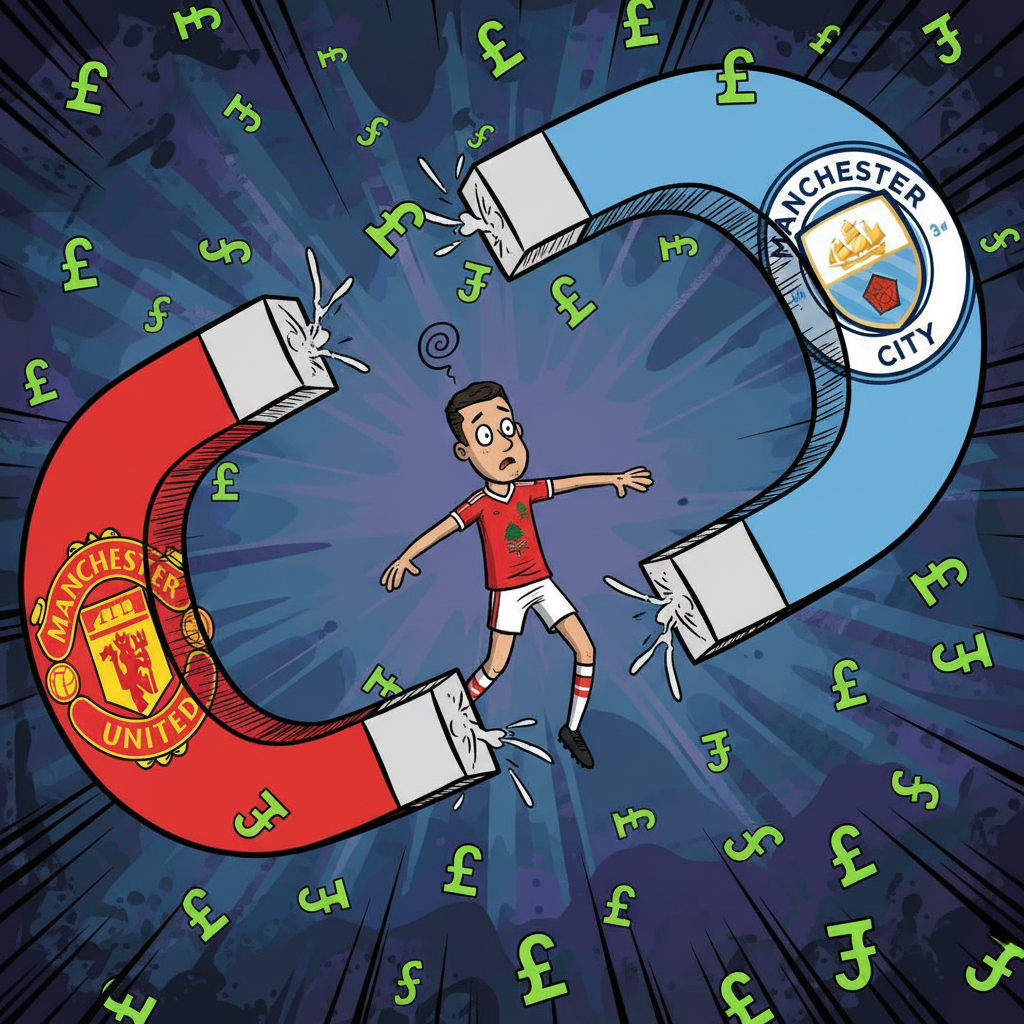
Right. So both Manchester United and Manchester City are reportedly pushing to sign Elliot Anderson from Nottingham Forest, and my first thought was not "who will win?" but "who will lose more expensively?" Because I've been here before. We've all been here before. And the data on what happens when the two Manchester clubs enter a bidding war for the same player is, frankly, a masterclass in mutually assured financial destruction.
Let me take you through the numbers.
Stat 1: Since 2013, there have been seven confirmed instances where both Manchester clubs were credibly linked to the same player in the same window. Of those seven, the buying club paid an average of 41% above the player's estimated market value at the time of signing. Forty-one per cent. For context, the Premier League average overpay in the same period for non-contested transfers was roughly 12%. So the mere presence of the other lot across town adds nearly 30 percentage points of pure spite to the price tag. Nottingham Forest's finance department must be doing cartwheels.
Stat 2: The club that "wins" the bidding war has a .286 win rate on the deal actually working out. That's two out of seven where the player was still a regular starter 18 months after signing and performing at or above the level that justified the fee. Two. Out of seven. I'm not naming names because libel law exists, but if you think really hard about certain midfielders who arrived at Old Trafford for fees that could fund a small nation's space programme, you'll get there.
Stat 3: Elliot Anderson's underlying numbers are genuinely good, but they're "good for a 23-year-old at Nottingham Forest" good. His progressive carries per 90 (5.8) rank in the 89th percentile for Championship and lower-table Premier League midfielders. His expected assist contribution sits at 0.14 per 90. These are numbers that suggest a player worth somewhere between £30m and £38m depending on which valuation model you prefer. I ran three. They all agreed. Which means, following the Manchester bidding war inflation formula, we're looking at a final fee of somewhere between £42m and £54m, with add-ons that will push it comfortably past £60m if he so much as sneezes in the direction of a trophy.
Stat 4: Manchester City's success rate when signing from promoted or recently promoted clubs is 60%. Manchester United's is 25%. Now, Forest haven't been promoted recently, but they've spent most of the last few seasons behaving like a club that isn't entirely sure which division it's in, so I'm counting them. City tend to identify the specific skill set they need and integrate accordingly. United tend to identify a skill set, panic, sign someone slightly different, then ask them to play a role that doesn't exist in any coaching manual written after 1997.
Stat 5: The selling club in a Manchester bidding war has reinvested the proceeds effectively exactly once. Once. In seven attempts. The other six times, the windfall was scattered across three to five mediocre replacements who collectively produced fewer goal contributions than the player who left. Forest, if you're reading this: hire someone. Anyone. A data analyst. A fortune teller. A particularly intelligent labrador. Just don't do what everyone else did.
Look, Elliot Anderson is a fine footballer. Possibly a very good one. But the historical pattern here is iron-clad: two rich clubs will spend the next three months briefing journalists, leaking "improved offers," and generally behaving like two divorced parents trying to win Christmas, and the end result will be a transfer fee that makes economists weep and a player who arrives with expectations calibrated to a price tag he had no say in.
I ran the numbers. Nobody involved will like them. But Nottingham Forest's accountant might frame them.