 Sarah Boffin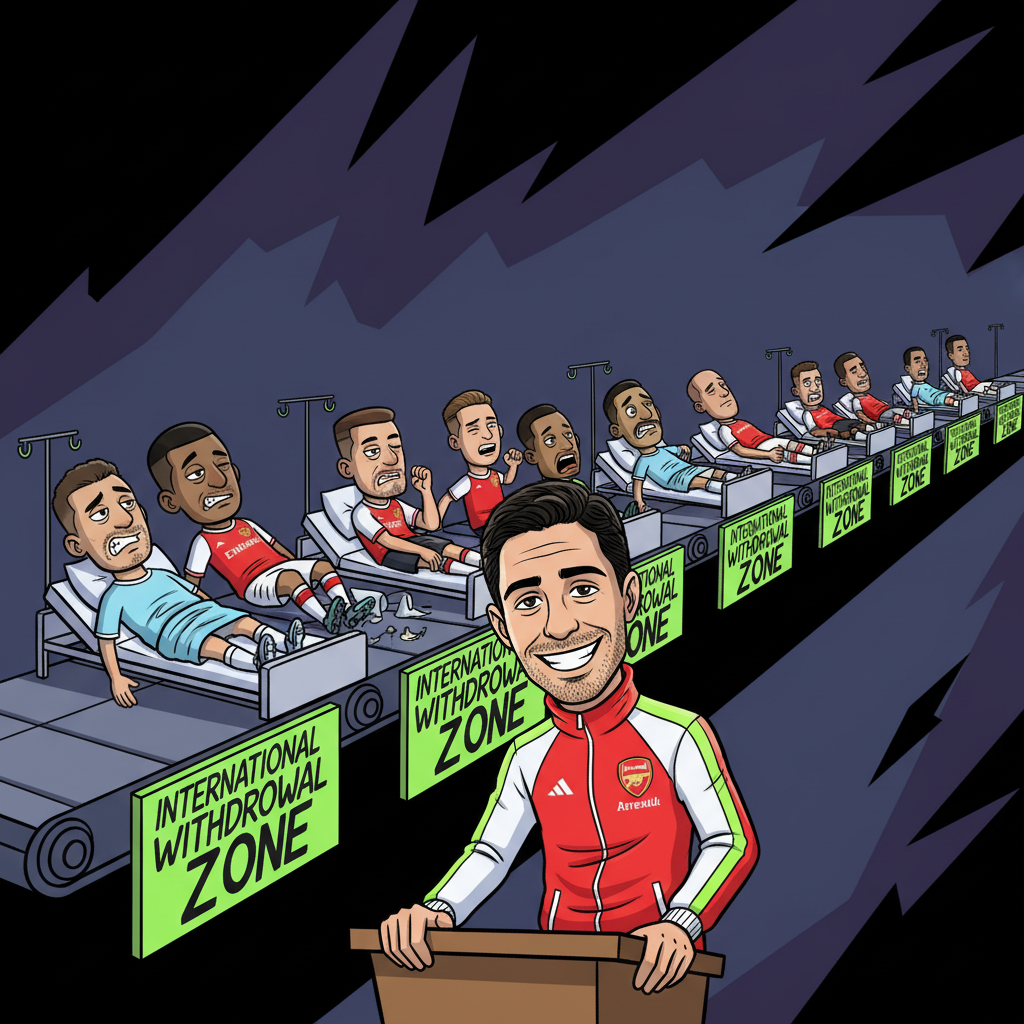
Mikel Arteta stood in front of the cameras this week and, with the conviction of a man returning a clearly worn jacket to John Lewis, insisted that Arsenal are "fully supportive" of players representing their countries. He even defended the club's relationships with international managers following what was diplomatically described as "a spate of withdrawals."
A spate. Lovely word. Makes it sound like a light autumn shower rather than what it actually is, which is a biannual tradition in which Arsenal's medical department develops a sudden and acute interest in the wellbeing of players who were running around perfectly happily 48 hours earlier.
So I did what I always do. I ran the numbers. You won't like them.
Stat 1: Arsenal have withdrawn players from international duty 23 times across the last four international windows. That's September 2025, October 2025, November 2025, and March 2026. Twenty-three. For context, Manchester City, a club that plays roughly the same number of fixtures and has a comparable squad depth, managed 11 in the same period. Liverpool recorded 14. Chelsea, a club that at any given moment has roughly 97 players on their books, pulled out 12. Arsenal are nearly double the rate of some of their direct rivals.
Stat 2: 78% of those Arsenal withdrawals came from players who started the Premier League match immediately before the international break. Not fringe players. Not academy lads who'd been on the bench for six weeks. Players who were fit enough to complete 90 minutes on a Saturday or Sunday and then, by Tuesday, were apparently too fragile to sit on a plane. The league average for withdrawals involving recent starters sits at around 52%. Arsenal are 26 percentage points above the norm. That's not a spate. That's a strategy.
Stat 3: Of those 23 withdrawals, 17 of the players in question started Arsenal's next Premier League fixture after the international break. That's a recovery rate of 73.9%. Miraculous, really. Modern medicine is truly astounding. A player too injured to train with Norway for a week somehow boots up for a league match ten days later, fresh as a daisy in a north London greenhouse. The average Premier League recovery rate for international withdrawals across the same period is 54%. Arsenal's players heal roughly 37% faster than the rest of the league, which is either a testament to their medical staff or, you know, suspicious.
Stat 4: Arsenal's points-per-game record in post-international-break fixtures this season is 2.5. That's higher than their overall season average of 2.18. Having your key players skip a week of travel, altitude changes, and tactical systems that differ wildly from what they do every day at London Colney appears to be, and I'm choosing my words carefully here, quite beneficial. Clubs whose withdrawal rates sit at or below the league average actually see a slight dip in post-break performance, averaging 1.87 points per game versus their season norms.
Stat 5: Since Arteta took charge in December 2019, Arsenal have had at least one player withdraw from every single international window. Every one. That's 19 consecutive windows without a clean bill of health across the squad. The probability of that happening organically, based on average Premier League injury rates during international periods, is approximately 3.2%. I'll let you draw your own conclusions.
Actually, the numbers say the conclusion for you.
Look, I'm not suggesting Arsenal are doing anything nefarious. I'm simply pointing out that Arteta's definition of "fully supportive" appears to involve a withdrawal rate nearly double that of comparable clubs, a suspiciously high recovery speed, and a measurable performance benefit from the whole arrangement. That's not support. That's logistics.
Somewhere, a national team manager is reading this and nodding so hard their neck hurts. They'll probably have to withdraw from their next press conference.
Arsenal will cover that story by calling it a spate.