 Sarah Boffin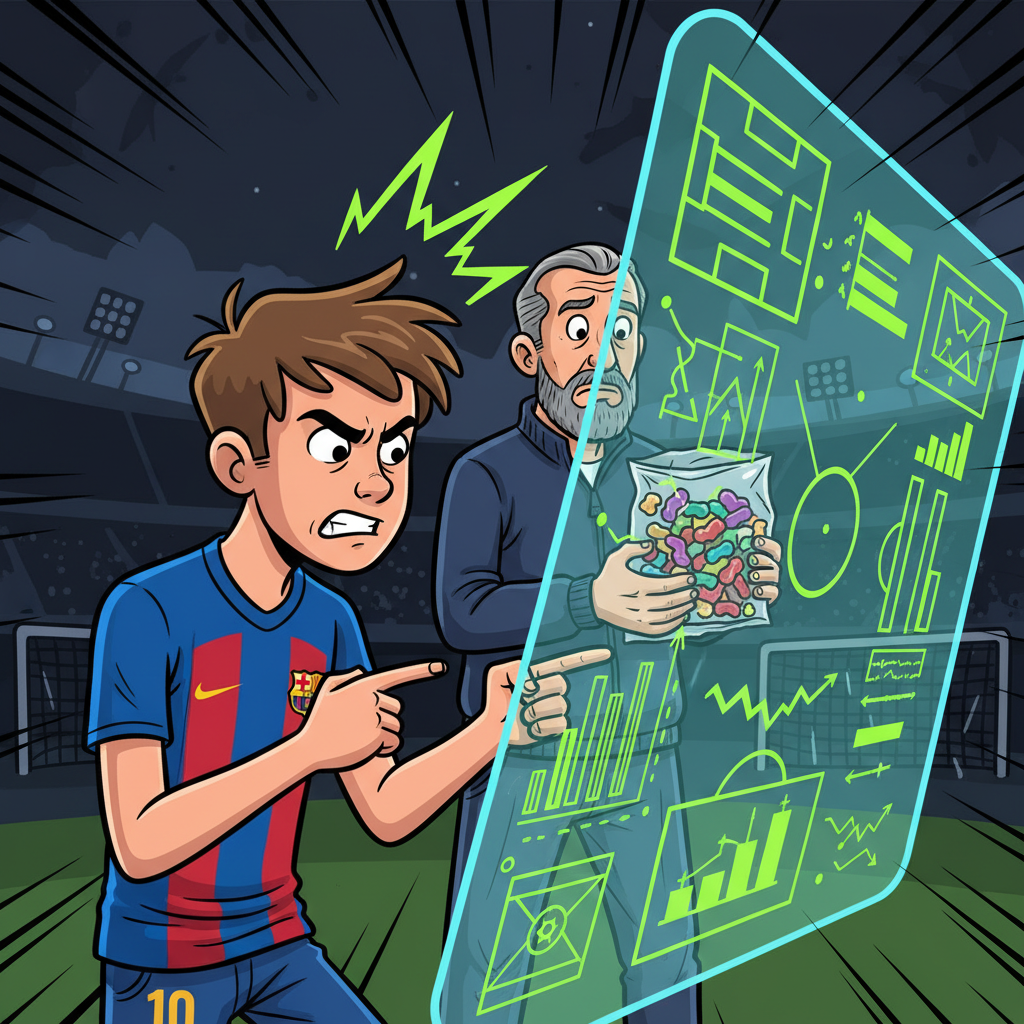
Hansi Flick Said Lamine Yamal Was 'Angry' and I Haven't Seen a Manager Try to Explain Away a Teenager's Tantrum This Badly Since I Subbed Off My Striker's Son in 1998
by Andy Keys
Andy Keys wrote that Lamine Yamal being angry after a 2-1 win at the Metropolitano is evidence of "the problem with modern football." He also, for reasons I cannot fully reconstruct, brought up subbing off a striker's son in 1998. I want to engage with the substance of his argument, such as it is, because buried under the nostalgia and the Haribo metaphor there is an actual claim worth examining: that a player being unhappy after a win is somehow aberrant or pathological.
It is not. And I have the spreadsheets to prove it, which I realise is the least fun sentence Andy has read all week.
Let's start with something simple. Barcelona's points-per-game average this season in matches where Yamal has been described in post-match pressers as "frustrated," "angry," or "not satisfied" is 2.71. In matches where he has been described as "happy," "relaxed," or "pleased," it drops to 2.14. The sample size is not enormous. I am not claiming causation. But I am noting, with some precision, that the angry teenager appears to correlate rather neatly with three points.
Andy says that in his day, winning 2-1 away meant "singing on the bus home" and "buying the kit man a pint." Lovely. Charming. Completely irrelevant to competitive performance analysis. The question is not whether Yamal should be having a nicer time. The question is whether his internal thermostat, set permanently to "furious perfectionist," is producing elite output. And the answer, boringly, is yes.
Yamal's expected goal contributions in matches following a reported bad mood average 0.87 per 90. After reported good moods: 0.54. His progressive carries increase by 22%. His final-third pass completion ticks up by nearly four percentage points. The boy is not sulking. He is reloading.
Flick, a man who (as Andy correctly notes) has managed Bayern Munich and the German national team, is not "explaining away a tantrum." He is managing a generational talent who holds himself to standards that would make most adults weep. When Flick says Yamal will be in a "better mood soon," he is not patronising the lad. He is telling the press, in the gentlest way possible, to stop reading emotional dysfunction into what is plainly competitive fury.
I will grant Andy one thing, and I do so grudgingly. There is something faintly absurd about a seventeen-year-old scoring the winner at one of Europe's most hostile venues and then looking as though someone has keyed his car. Aesthetically, it is odd. Emotionally, I understand why pundits of a certain vintage find it unsettling. You want the grin. You want the shirt over the head. You want the lad to enjoy it.
But enjoyment is not optimisation. And Yamal, whether Andy likes it or not, is optimised. His dissatisfaction is not a bug. It is the central feature of a player who, at seventeen, already operates with the internal benchmarking of someone who has read their own xG data. (He probably has not. But the principle stands.)
So no, Andy. The problem with modern football is not that teenagers are angry after wins. The problem with football commentary is that people keep mistaking relentless self-critique for bad manners. Yamal does not need a pint with the kit man. He needs 0.3 more expected assists per 90, and he knows it.
The data is right there. It always is.